For more than 40 years, Washington State University Extension scientist Gary Chastagner has found solutions to Christmas tree diseases and other related problems, helping ensure the beloved holiday tradition remains possible.
Known worldwide as “Dr. Christmas Tree,” Chastagner has also played an important role in keeping Christmas tree farms in the Pacific Northwest and beyond economically viable.
“When I receive letters of support from family Christmas tree farmers expressing how our research has had a positive impact on their ability to produce high-quality trees, I share them with everyone in our lab,” said Chastagner, who is based at the WSU Puyallup Research and Extension Center. “I say, ‘This is why we’re doing what we’re doing.’”
Chastagner didn’t intend to become one of the world’s foremost experts on tree and ornamental flower bulb pathologies. But a biology teacher’s enthusiasm proved infectious in his formative years, and Chastagner’s curiosity about plants and their pathologies took root.
After charting a career path through a doctorate to work on fresh-market tomato diseases, he faced a choice between two job offers: one on the East Coast at Rutgers and one on the West Coast at WSU.
“My wife’s family is from the West Coast, and my family is from the West Coast, so WSU Puyallup won out,” he said with a laugh.
Hired in 1978, Chastagner first focused on managing diseases of ornamental bulb crops and turf grass. But that same decade, the U.S. Christmas tree industry experienced a widespread disease problem. Swiss needle cast was causing Christmas trees to prematurely lose needles, reducing the marketability of about 15% of Douglas-fir trees, which accounted for about 90% of the industry’s production. Chastagner was tapped by WSU to help solve it.
Surveys revealed that more than 80% of Douglas-fir trees had diseased needles, representing a $3.5 million loss at harvest.
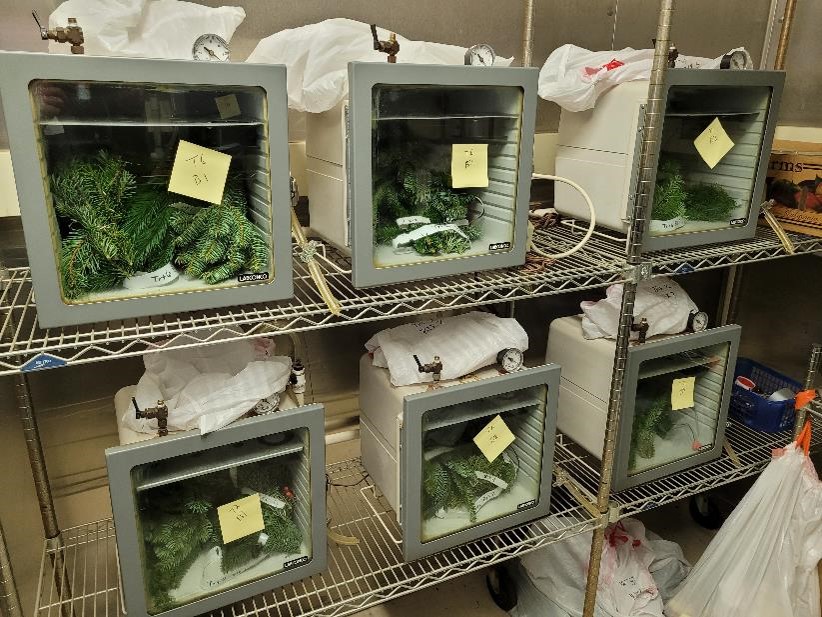
Chastagner asked a colleague at his alma mater, the University of California, Davis, to set up an experiment. He shipped infected-but-healthy-looking trees from the WSU Puyallup Research and Extension Center to Davis, California, to see if the infected needles’ presence had any effect on the postharvest quality of trees after shipment and display indoors. The researchers were shocked by the results.
“Healthy-looking trees that had Swiss needle cast dried out twice as fast as the uninfected trees,” Chastagner said. “It was a piece of the puzzle that we found through experimentation and science.”
Trees in research trials west of Mount St. Helens provided crucial information that helped growers develop a needle cast management strategy that cost five cents per tree per year and required applications for just two or three years prior to harvest, Chastagner said.
“So 15 cents per tree eliminated a $3.5 million loss at harvest and doubled the postharvest life of all trees,” he said.
An excitement for discovery has permeated Chastagner’s work ever since. He shares that enthusiasm during a recurring conference for western U.S. and Canadian Christmas tree research and Extension personnel that he helped kick off in the mid-1980s. The sharing and collaboration resulted in many impactful research projects over the years. The conference tradition continues today.
Chastagner’s career timeline is punctuated with a variety of other accomplishments. His lab developed the concept of a threshold moisture level that predicts how much a tree can dry out after cutting before it loses needles and can’t rehydrate when displayed indoors.
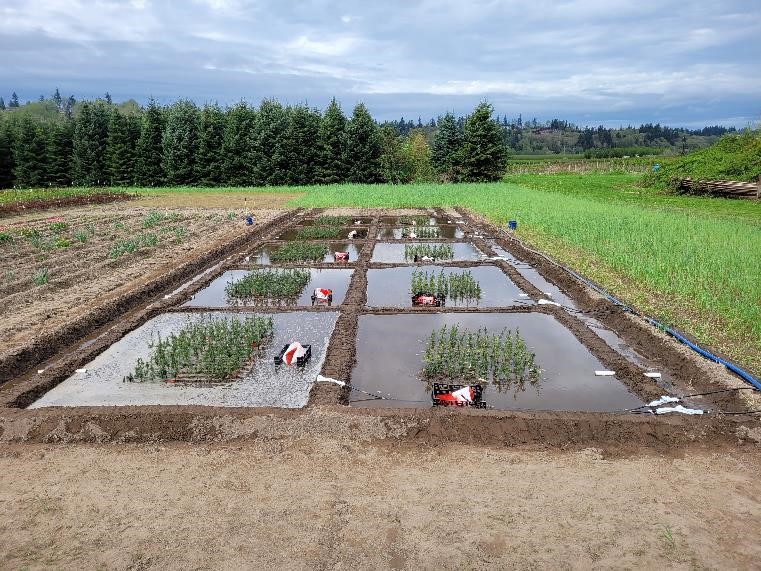
The professor’s team also developed a simple detached branch test to identify trees that have superior needle retention. He has tackled root rots and traveled the world to find new Christmas tree varieties that are resistant to common pests and diseases and can tolerate a changing climate.
For all this and more, Chastagner was honored with a lifetime achievement award from the National Christmas Tree Association in 2018.
How is Dr. Christmas Tree able to accomplish so much? Only through a team effort.
“It’s because of the staff, students, and postdocs who work in the Christmas tree program, our domestic and international collaborators, supportive stakeholders, and the opportunities that exist at the WSU Puyallup Research and Extension Center,” Chastagner said.
“There’s no substitute for people with an interest and passion for what they’re doing,” he added. “That comes through to peers and to our stakeholders.”