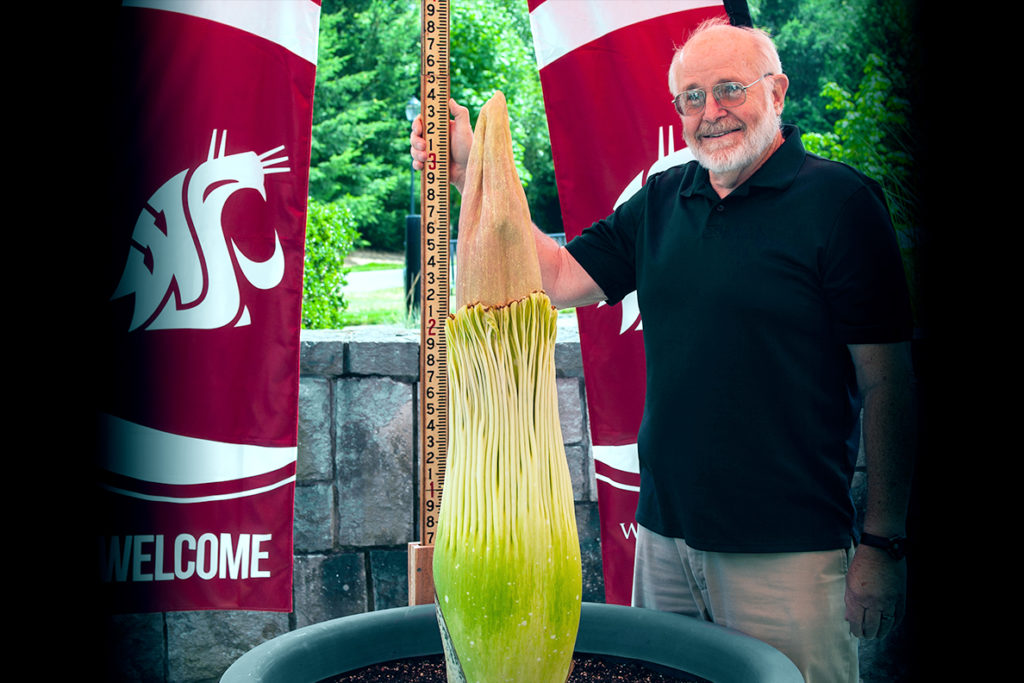
A rare corpse flower housed at Washington State University Vancouver is poised to bloom for its first time at the end of July or the beginning of August.
Titan VanCoug, as it is known on campus, is currently on display outside the greenhouse at the east end of the Science and Engineering Building. It’s growing a couple of inches a day as it works up to a full bloom. The corpse flower is infamous for its odor—comparable to that of a decomposing animal—when it blooms. The bloom will last 24 to 48 hours.
Come see this rare plant now through its bloom:
- 8 a.m.–9 p.m. Monday through Friday
- 10 a.m. to 6 p.m. Saturday and Sunday
(Hours may adjust if the bloom occurs over a weekend.)
Check in on Titan VanCoug any time via live webcam.
About the corpse flower
The corpse flower (Latin name Amorphophallus titanum, also known as titan arum) is native to the limestone hills of Sumatra, Indonesia’s rainforests, the only place in the world where it naturally grows.
They are among the world’s largest and rarest flowering structures. They bloom rarely—typically after seven to 10 years of growth and just once every four years or so afterward throughout a 40‑year expected lifespan.
A corpse flower’s odor is not without reason. It’s meant to attract pollinators and help ensure the continuation of the species. Dung beetles, flesh flies and other carnivorous insects that typically eat dead flesh are attracted to the corpse flower.
About Titan VanCoug
Titan VanCoug has been raised by Associate Professor of Molecular Biosciences Steve Sylvester. He planted a seed from the University of Wisconsin-Madison’s titan arum plant, affectionately named Big Bucky, in 2002. He cultivated it in a pot on his desk until it grew too large to contain in such a small space. It has grown in a stairwell in WSU Vancouver’s Science and Engineering Building for some time.
A late bloomer at 17, Titan VanCoug’s first bloom was most likely delayed because its corm (tuber) cloned. Corpse flowers put up only one leaf at a time. The pot that contains Titan VanCoug has had as many as four leaves showing at once.
Media contact:
- Brenda Alling, WSU Vancouver Office of Marketing and Communications, 360‑546‑9601, brenda_alling@wsu.edu