Tax season can be a headache—the American tax system is a web of confusing rules that can be even more difficult for international students to navigate.
To comply with their immigration status, all international students must file a tax form with the Internal Revenue Service, regardless of whether they earn income. Thankfully, with the help of Carson College of Business volunteers, international students can file their taxes with experts for free.
For the first time, the Nonresident Tax Help Group Volunteer Income Tax Assistance (NoRTH VITA) program is providing tax clinics to F-1 and J-1 visa-sponsored students.
Tax clinics are offered in person at the following times:
- Saturday, March 29, 1:00-3:30 p.m. in CUE 119
- Monday, April 7, 5:00-7:30 p.m. in SPARK 339
Volunteers ask that students set an appointment ahead of time. Sign-up is available on the NoRTH website using a WSU email address. Participants need to bring their passport, I-20, DS-2019, and travel history documents. They should also bring income documents such as a W-2, 1042-S, Form 1099, and a computing device to file online. Volunteers cooperated with International Programs Student and Scholars Services to reserve rooms and line up IT support for the tax workshops.
For international students who did not earn income, the 8843 Form (which also must be filed on behalf of dependents in the US accompanying an international student) is fairly simple and can be done independently. But things get a bit more complicated if international students earn income in the U.S.
Jeff Gramlich, professor of accounting, has coordinated with CCB student volunteers for the past seven years to offer free tax help at the Neill Public Library in Pullman. He said he first started helping student-athletes who came from abroad but now has enough qualified volunteers to offer tax services to more students. Individual countries negotiate tax treaties with the US, so no single international student is taxed the same on their income earned in the US.
Gramlich said during a recent tax clinic he had a student from Nigeria and a student from Peru sitting next to each other. The Nigerian student ended up owing taxes, while the Peruvian student received a tax refund.
“One gets a refund and the other has to pay because one country negotiated a nicer tax treaty,” Gramlich said. “But almost without exception students are totally mystified by it and not fighting the process.”
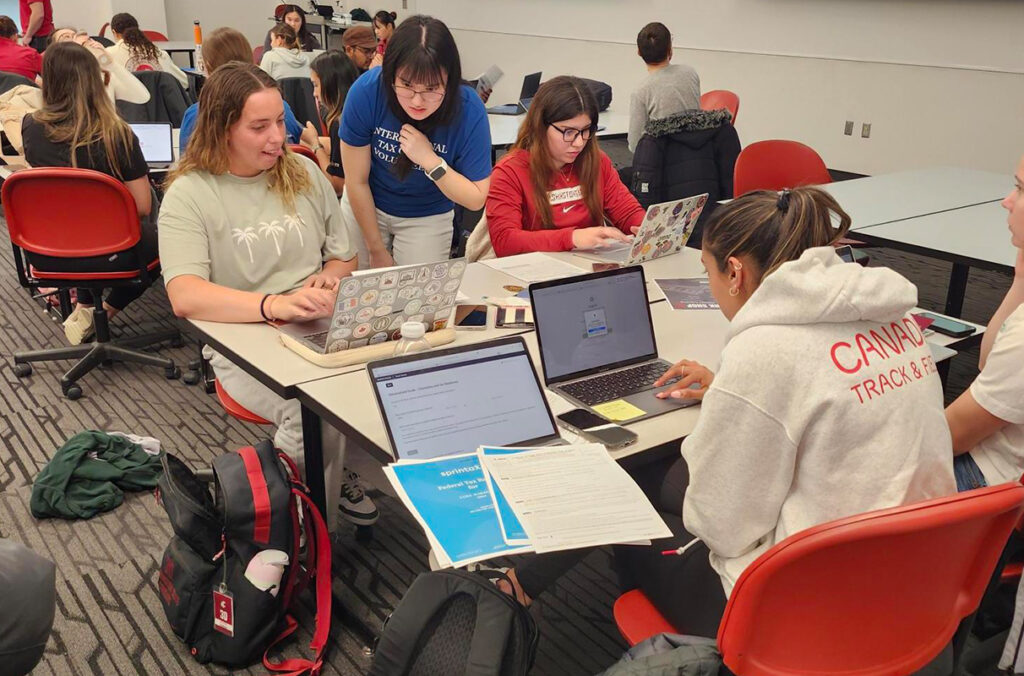
Gramlich said he and his four student volunteers love assisting people with their taxes and finding unique deductions or just helping students traverse the confusing tax structure. But given the limited number of volunteers, he asks that students set appointments ahead of time. During a recent tax workshop more than 30 students attended, and volunteers were harried by questions while attempting to assist students hailing from Canada, Iran, United Arab Emirates, Turkey, and many more countries.
America is unique in requiring its populace to file individual taxes. In much of Europe and the rest of the world, yearly tax estimates are completed by governments and sent out to citizens, who review and either approve of or dispute the filing. Many countries have no income tax.
“That whole notion of income tax is foreign for many of our students,” Gramlich said.